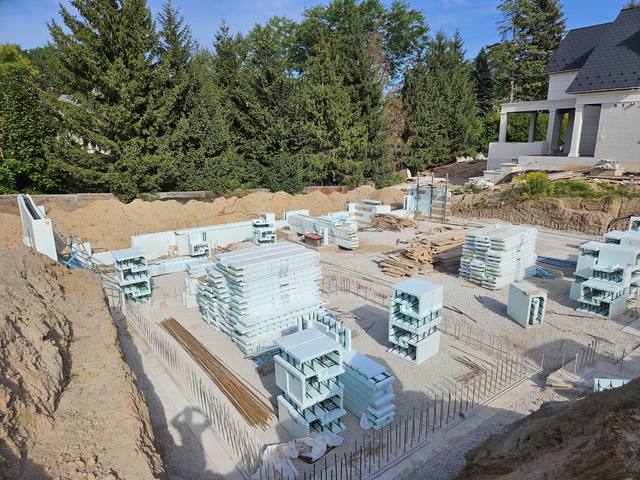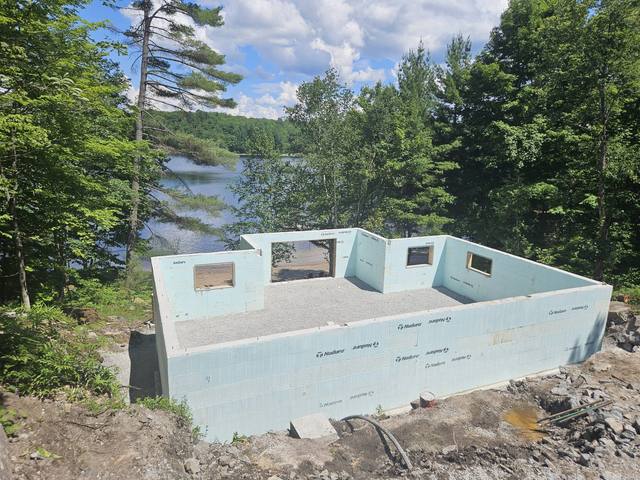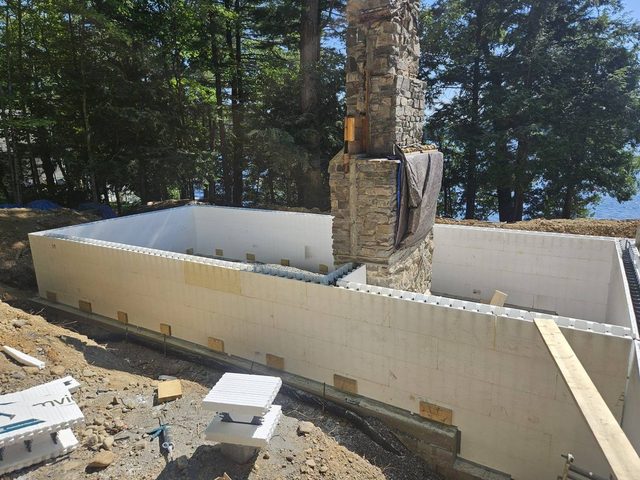
Is ICF construction worth it? For a house you plan to heat through Ontario winters and keep for a long time, yes, and the reasons are mostly ones you can check on a bill. The premium is real, and it is paid once, on day one. What comes back arrives every month after that. On Georgian Bay, where the lot is often rock and the wind comes straight off open water, the case gets stronger rather than weaker.
That is the short answer. The useful one is a list of what the extra money buys back, which items on that list are solid, and which ones a salesperson will lean on harder than they deserve.
The Premium Is the Only Real Downside
We get asked for the honest downside of ICF on almost every call. The answer is the upfront cost. Nothing else. Wall for wall, an ICF house usually carries a modest premium over conventional framing, and we would rather tell you that on the phone than have you find it in the quote.
“Modest” is doing real work in that sentence, because the comparison most people make is the wrong one. They price a block against a stud. The fair comparison is a finished ICF wall against a finished framed wall: studs, batts, vapour barrier, strapping, and the labour to put each one up. An ICF wall arrives with all of that in it. Below grade there is no interior stud wall to frame, no batt insulation to fit, no vapour barrier to hang and no strapping, which takes three trades and three material orders off the budget before anyone has talked about energy.
The detailed numbers are in what ICF actually costs compared to wood frame. This post is about the other side of the ledger: what you get back.
Is ICF Construction Worth It on the Heating Bill?
If you only ask “is ICF construction worth it?” about one thing, ask it about the heating bill. This is the biggest return, and it is the easiest to underestimate, because the number on the label hides it.
A 2x6 framed wall is rated R-20 to R-22. That rating is measured on the insulation, not on the wall. Every stud interrupts the batt and heat takes the easier path through the wood, so once the framing is counted that wall often performs closer to R-17, and it drops again at every window and door. Then there is the junction where the foundation stops and the sill plate, floor and framed wall begin. A house has one of those at every storey.
An ICF wall delivers an effective R-22 to R-26 with nothing bridging it, and when the ICF carries up from the foundation those junctions never exist. The rating on the label is only half the story; the other half is how much of the wall actually performs at it.
Why that matters so much: according to Natural Resources Canada, space heating is the largest single use of energy in Canadian homes, at 61% of residential energy use in 2020. Water heating, lights and appliances are all in the remaining share. Whatever you save on the walls, you save on the biggest line on the bill, every month the furnace runs, for as long as the house stands. For the physics behind it, see are ICF homes more energy efficient.
What You Stop Maintaining
The second return is quieter. A reinforced concrete wall does not rot, and it does not give mice and insects a cavity to move into. The foam faces protect the concrete from freeze-thaw swings and moisture. What is left to maintain is the cladding and the roof, the same as any house, without a wall cavity behind them that can go bad unseen.
The basement changes category too. With continuous foam on both faces, an ICF basement is warm from day one and drywall fastens straight to the webs cast into every block. It is living space you would have paid to finish anyway, not storage you put off finishing because it is cold and damp.
And there are things you hear about less until you live with them. The mass of the concrete plus continuous foam makes a noticeably quieter, draft-free house. Nobody puts that on a spreadsheet, and it is there every day you live in the house. We went further into lifespan in how long do ICF homes last.
Insurance: Count It When It Is in Writing
This is where the sales pitch usually gets ahead of the facts. You will read that an ICF house costs less to insure. It might. Insurers set their own rates, weigh construction type their own way and change their minds, and none of that is something a builder controls or can promise.
So do the sensible thing. Before you decide, ask your broker to quote the same house twice, once framed and once in reinforced concrete, and put the difference in the math only if it comes back in writing. If it does, it is a bonus on top of a case that already works. If it does not, the case still works. Do not let anybody, us included, put a discount on the table that your insurer has not.
Resale: What a Buyer Can Actually Check
The same caution applies when you sell. A buyer, and the appraiser working for their lender, mostly prices what every listing shows: size, lot, location, finishes. Concrete walls are not a line on most listings, and a buyer who does not know what ICF is will not pay extra for a word.
What a buyer can check is what the walls did. Keep the heating bills. Keep the drawings and the spec for the wall system. A finished basement that is warm in January, rooms that are quiet with a highway or a lake wind outside, and a year of utility bills are evidence a buyer can weigh. The premium earns its keep at sale through those, not through the word ICF in the listing.
That is also the honest way to look at the whole question. Is ICF construction worth it to you, or to whoever owns the house next? If you are building to sell within a couple of years, most of the return lands with the next owner. If you are building to live in it, all of it lands with you.
On Georgian Bay, the Lot Changes the Sum
Plenty of lots on Georgian Bay are not flat suburban squares. On the eastern shore the ground is Canadian Shield granite, often bare, and the lot falls toward the water. That changes what a conventional build costs before the walls start: footings on rock, a foundation that steps with the grade, and a building that takes the wind off open water broadside. A lot like that is where the case for ICF is strongest.
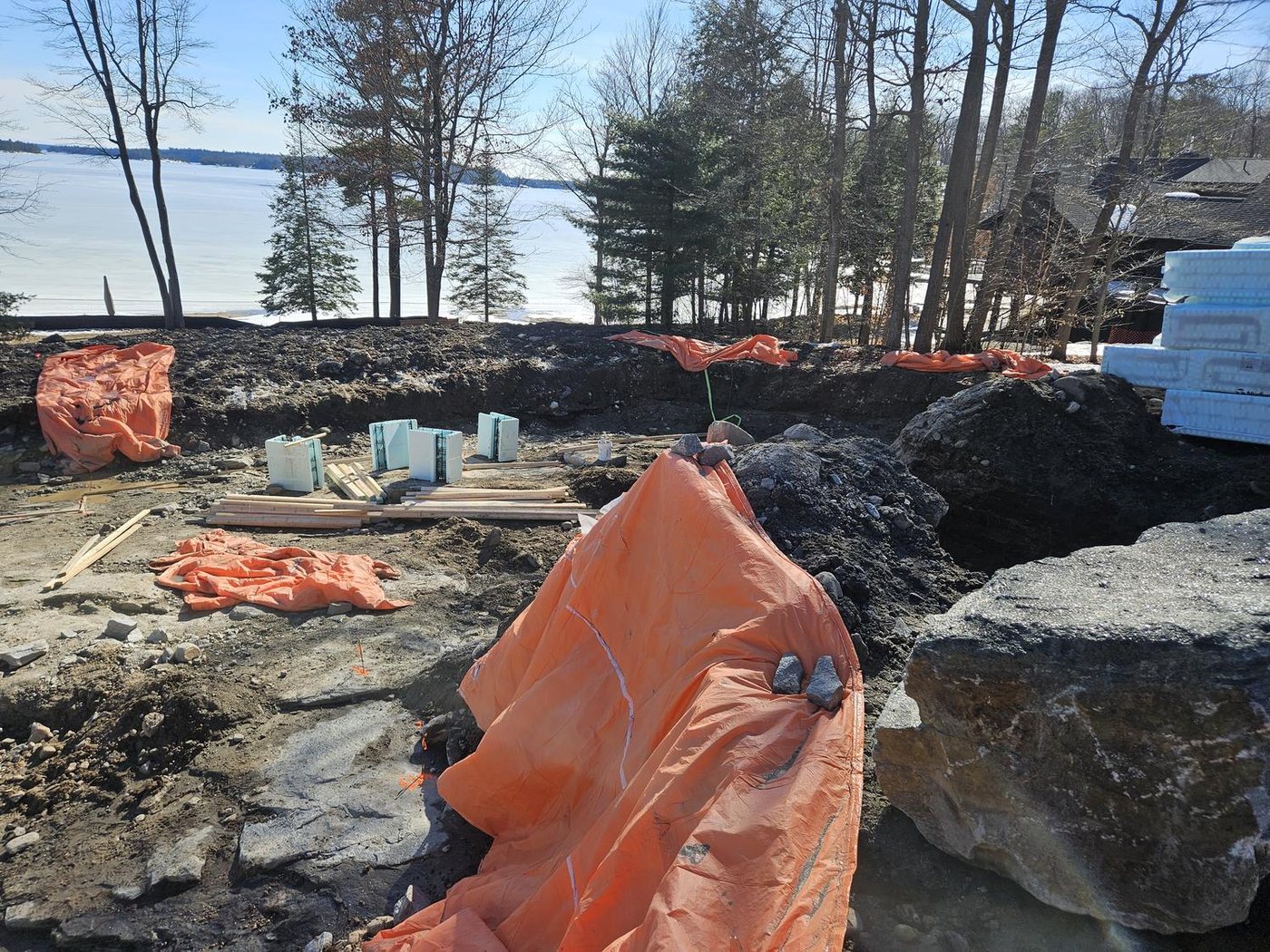
ICF suits that kind of site. We scribe footings onto shoreline granite and pin them to it, or scribe the ICF straight onto the rock, whichever the site and the engineering call for, and stepped ICF foundations follow the grade instead of fighting it. A reinforced concrete core stands up to wind and weather in a way framing does not. Our footings on bedrock page shows how that work is done.
Two more things change the sum on a waterfront lot. The first is permits: along the southern shore the Nottawasaga Valley Conservation Authority regulates development near the Georgian Bay shoreline, and setbacks and site-alteration rules vary by municipality and authority. We flag those during consultation so they shape the design rather than stop it. The second is that a lot of these buildings are cottages.
Is ICF Construction Worth It for a Seasonal Cottage?
Even for seasonal use, yes, though the reasons shift. A cottage that sits closed from Thanksgiving to May is mostly about durability, pest resistance and being able to lock it and leave it. Concrete construction needs little maintenance and resists pests and weather while nobody is there. And it keeps an option open that matters more than it sounds: making the cottage four-season later, without touching the structure. A framed summer cottage turned into a winter one starts with opening the walls. An ICF one already has the walls for it.
More on that in cottages and retreats.
When the Sum Does Not Work
Is ICF construction worth it every time? No. There are honest cases where it is not, and they are narrower than people expect.
A building you will never heat gets the strength of the concrete and none of the energy return, so the insulation is money spent on nothing. A house built to sell quickly, in a market that does not price it, hands most of the payback to the next owner. And a plan with walls that will be moved in five years is a poor fit for a wall made of reinforced concrete; changes after the pour are concrete work. We covered the rest in insulated concrete forms disadvantages.
Outside those, the comparison usually comes out the same way. Schedule is not a cost against it either: ICF walls go up faster, not slower.
So, Is ICF Construction Worth It?
For a home you will heat and keep, on most lots and especially on a hard one, yes. The premium is paid once and it is smaller than a block-against-stud comparison makes it look. The heating return is the largest and the most certain. Maintenance and comfort come next. Insurance and resale are real only when someone puts them in writing or on a bill, so treat them as a bonus.
The way to know for your house is a quote that shows the numbers rather than a feeling about them. We give a site walk, a consultation and an itemized quote, free, and Jerry would rather take a line off your quote than sell you a detail the assembly does not need. We build across Georgian Bay, Simcoe County and Muskoka with our own crews, with Nudura among the ICF systems we are certified to install. If you have a lot and a plan, send them over and we will tell you straight whether ICF is worth it for that house.