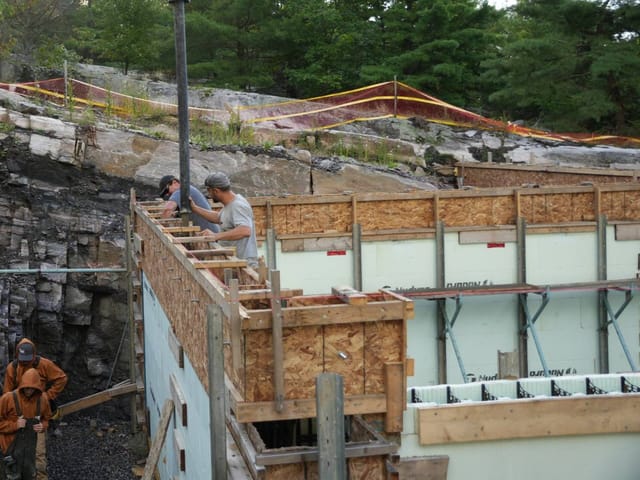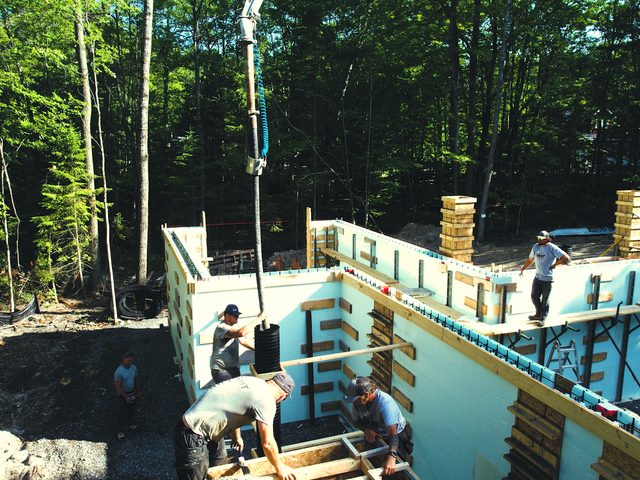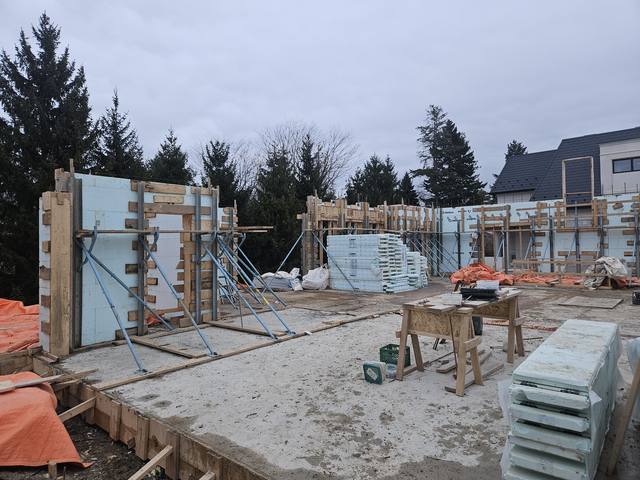
Electrical in ICF walls is mostly done after the concrete is in, and that surprises people the first time. There are no studs to drill and no cavity to fish a cable through. The wire goes into the foam itself, in a groove the electrician cuts after the walls are poured. Only a short list has to be in the wall before the pour, and that list is where the expensive mistakes live.
What Changes When the Wall Has No Studs
A Nudura wall is two panels of expanded polystyrene, each 2 5/8 inches thick, with reinforced concrete between them. Plastic fastening strips run the full height of the block every 8 inches, recessed 5/8 of an inch behind the foam face. Those strips are the studs, as far as anything that needs a screw is concerned.
So the electrician's job changes shape. On a framed wall they bore holes through studs and pull cable through the cavity. Here there is no cavity. They cut a channel, called a chase, into the inside foam, press the cable into it, and set the boxes into pockets cut the same way. The concrete behind stays untouched.
It sounds slower. It usually is not. A straight chase cut to a chalk line goes quickly, and there is no insulation to pull back, no fire blocking to drill around and no poly to tape afterwards.
Electrical in ICF Walls Starts Before the Pour
Most of the work waits for the concrete. The exception is anything that has to cross the wall. Once the core is full, the only way through is a drill and a lot of patience.
Nudura's manual is specific about it. Before concrete goes into the forms, PVC sleeves are set through the wall, held in with low-expansion spray foam, wherever electrical service runs in or out: the feed from the meter, exterior lights, outdoor receptacles, power to a garage or shed, pole lighting on the property. Each sleeve sits about 6 inches to the side of where its box will be, so the wire can come into the side of the box and the box can still fasten solidly to the concrete. After the wire is pulled, foam goes around it to seal the opening.
Miss one and it can still be done. A hole can be drilled through the wall after the pour. But that means coring through reinforced concrete and hoping not to meet the steel, for a hole that would have cost a length of pipe and a minute with a keyhole saw. This is why we form service penetrations in rather than cut them in later.
The other early item is where chases will pass between the rim joist and the foam. Nudura suggests the electrician lays those out before the floor goes on, as a chase in the foam or a run of conduit fastened to the concrete. Once the floor is down, that strip of wall is hard to reach.
Where the Panel and Meter Go With Electrical in ICF Walls
Put the main panel on the inside of the same wall the meter is on, directly opposite it where you can. That keeps the service run short and gives easy access up through the ceiling or down through the floor. If that will not work, keep the panel as close to the incoming service as the layout allows.
A panel does not screw straight to foam. Nudura's method is a larger base of 1/2-inch plywood, fastened with screws to the strips or with longer concrete screws into the wall, and the panel mounts on that. The wires can then be stapled neatly to the plywood, which is the one place in an ICF house a staple has anything to hold. If you want the wiring hidden, the plywood gets furred out with 2x4s, and the foam behind needs its thermal barrier on first.
The meter goes on the outside on a piece of exterior plywood anchored through shims to the concrete with galvanized concrete screws. That detail depends on the exterior finish, so the finish has to be decided before the meter goes up. A meter mounted for siding sits wrong in stone.
Cutting the Chases
Chases get cut once the walls are poured and, usually, once the roof is on. Nudura names three tools as the fastest and cleanest.
- An electric chainsaw with a depth stop made from a short length of threaded rod through the bar. The bar and chain cut a groove the cable fits snugly, and the stop keeps the tip off the concrete.
- A hot knife, which melts the foam rather than tearing it. It comes with a depth plate and blades that bend to any profile. It is the best tool for cutting box pockets because it leaves a clean back, though the blade has to hold its heat to cut evenly.
- A reciprocating saw with the blade cut down so it goes no deeper than 2 inches into the foam.
Horizontal runs follow a snapped chalk line. Vertical ones follow the lines moulded into the face of the form. Neither is hard. Both are faster than drilling a stud wall, and nothing structural is touched along the way.
How Deep the Cable Has to Sit
This is the part most worth understanding, because it decides whether someone hanging a picture in five years drives a screw into a live wire.
Gypsum board goes over the foam as its thermal barrier, and screws go through that board into the strips. Most electrical codes want at least 1 1/4 inches between the outside of the cable's sheathing and the back of that board. A cable pressed to the bottom of a 2-inch chase clears it. A cable that rides up in a sloppy chase may not. Where a run genuinely has to sit closer to the surface, a galvanized steel plate goes over it, the same protection a framed wall uses where a cable passes too near the face of a stud.
Holding the cable in is its own small problem. Staples do nothing in foam or concrete. A snug chase holds a cable by friction. A wider one gets a bead of low-expansion spray foam, or a clip screwed into the concrete. Some codes also want the cable secured within 8 inches of every box, which in ICF means a nylon zip tie or a cable clamp with an eyelet for a short concrete screw, or a shot of foam at the box.
All of this gets inspected before the walls are closed. Electrical in ICF walls is held to the same code as electrical anywhere else, and the inspector looks at it before the board goes on.
Boxes, and the Air Leak Nobody Thinks Of
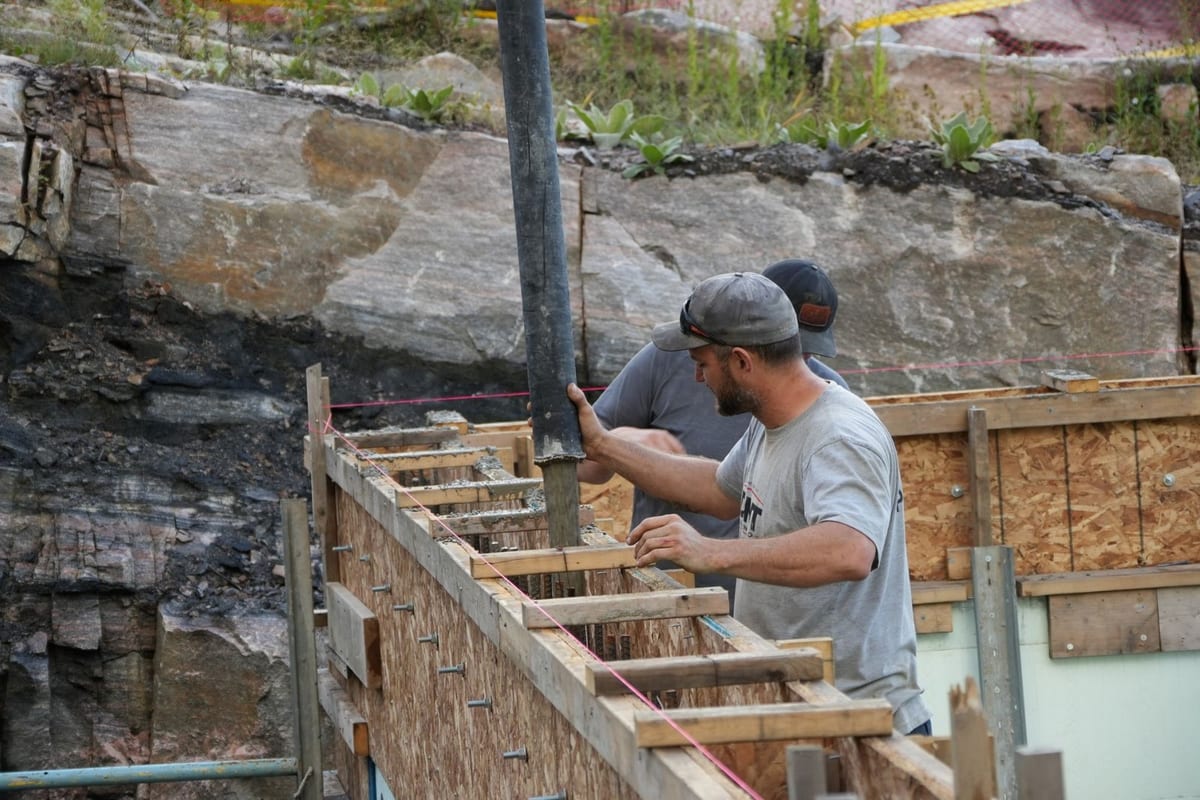
Metal and plastic boxes both work. The pocket for each is cut after the pour, most cleanly with a hot-knife box attachment, or with a heated metal box pressed into the foam like a branding iron. The wires go into the box before it is fastened.
How it fastens depends on the box. One with a stud flange screws to a fastening strip, and there is one every 8 inches. Others are anchored through the back into the concrete with a concrete screw or a plug and screw. A multi-gang box may want both. How many wires each box can carry is set by the electrical code, not by the wall.
The part people miss is air. A box pocket is a place where the foam has been cut thinner than the rest of the wall. Nudura recommends sealed vinyl boxes for that reason, with a vapour barrier only at the box itself. For a metal box, a moulded polyethylene insert goes into the pocket first and is taped to the foam face. It is a small detail on a wall that is otherwise one continuous layer of insulation, and it is the difference between a wall that performs as designed and one with a few dozen small leaks at every outlet.
Conduit, If You Want It
Conduit, metal or plastic, goes into chases after the pour the same way cable does, clipped and screwed back to the concrete core. Plastic conduit can also be cast right into the wall, but only when the electrician is on site every day before the pour: the 90-degree bend and the box have to be set first, with the box on a shimmed plywood patch screwed to the webs so it stands proud of the foam.
Nudura's own advice is that running conduit in the foam after the pour is far more efficient and less expensive. Cast-in conduit earns its place where a run must be protected inside the wall. For most houses it is work done early for little gain.
Electrical in ICF Walls: What to Settle Before the Pour
Almost everything inside can wait until the walls are standing. A short list cannot:
- Every place service crosses an exterior wall: the meter feed, outdoor lights and receptacles, a garage, shed, pump house or post light.
- Where the meter and the main panel go, and the exterior finish on that wall.
- Where wiring has to pass the rim joist between floors.
- Any conduit you want cast into the core rather than run in the foam.
The wiring itself is your electrician's work, and the inspection is theirs to book. What we control is the wall it goes into. Our own crews self-perform the concrete and ICF scope and work alongside your builder and trades rather than replacing them. We are certified installers for Nudura, Amvic, Element and Fox, and we give architects and designers constructability input on ICF details before the drawings are finished. Send the electrical layout with your quote request, even a rough one, so the sleeves can be formed in where they belong the first time. How the rest of the inside gets finished is covered in finishing ICF basement walls, and what we form into a foundation is on our ICF foundations page.