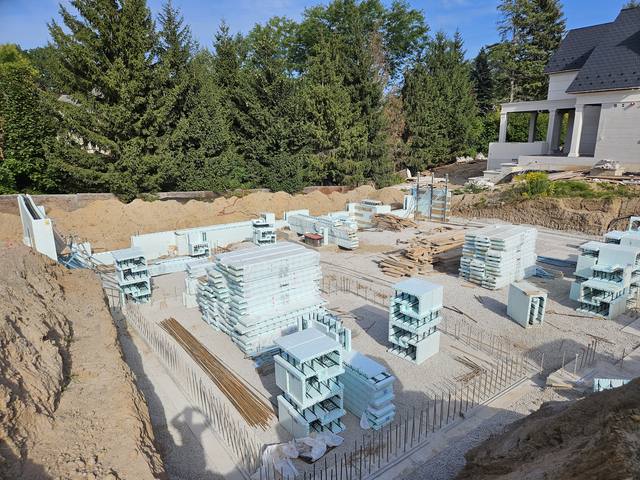
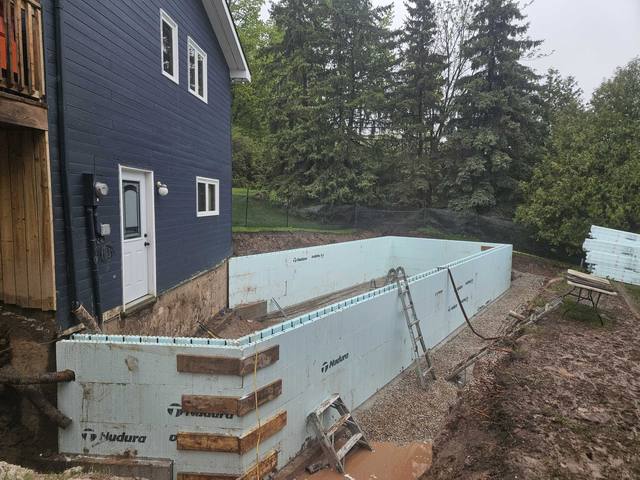
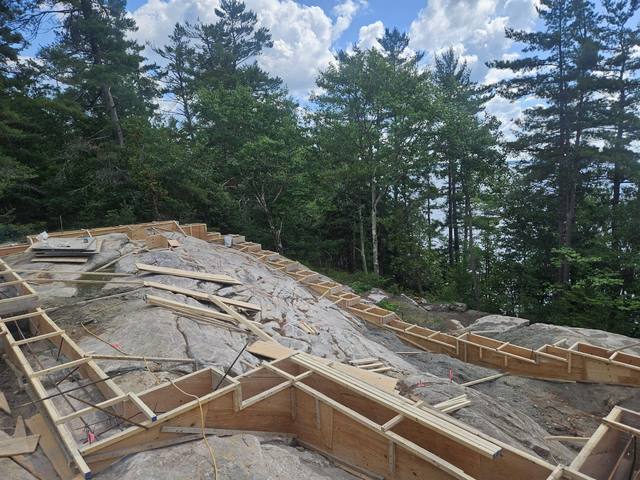
Every day of a foundation build is recoverable except one. An ICF concrete pour takes a few hours, involves a truck you are paying for by the hour, and fills a form you cannot open again. Everything before it is preparation for it, and everything after it inherits whatever it produced.
That is why the crew looks calm in the photos. The hard thinking happened days earlier.
What has to be true before the truck arrives
By the time concrete is on site, the wall has already been decided. The pour just makes it permanent.
Bracing and alignment. The forms are braced and aligned on scaffold, plumb and straight, before anything is placed. Wet concrete is heavy and it pushes outward on every square inch of form it touches — a wall that is out by half an inch dry will not correct itself under load, it will get worse.
Rebar. The reinforcement schedule is tied inside the cavity, at the spacing and lap the engineering calls for. Once concrete is in, nobody can check it and nobody can fix it.
Everything that has to be a hole. Window and door bucks, beam pockets and service penetrations are formed into the wall now. Cutting a beam pocket into cured concrete afterwards is a bad afternoon with a saw; forming one in costs nothing but planning.
Access. A pump truck needs somewhere solid to set up with enough reach to cover the whole plan, and a ready-mix truck needs to get to it. On a wooded or rocky lot that is a real constraint, not a detail.
Why an ICF concrete pour goes in lifts
The instinct is to fill the wall like a glass. Do that and you will find out what a blowout is.
Fresh concrete behaves like a liquid, and the pressure it exerts on the form grows with depth. Fill an ICF wall in one continuous go and the pressure at the bottom can exceed what the form and bracing are rated to hold. Forms bulge, seams open, and in the worst case the wall comes apart with several cubic metres of concrete already in it.
So the wall gets filled in lifts — placed in horizontal passes around the whole perimeter rather than top to bottom in one spot. Each pass lets the concrete below start to stiffen and shed pressure before more weight goes on top of it. The maximum lift height is set by the form manufacturer, not by how the day is going.
This is also why the crew keeps moving. Standing still and filling one bay is the mistake.
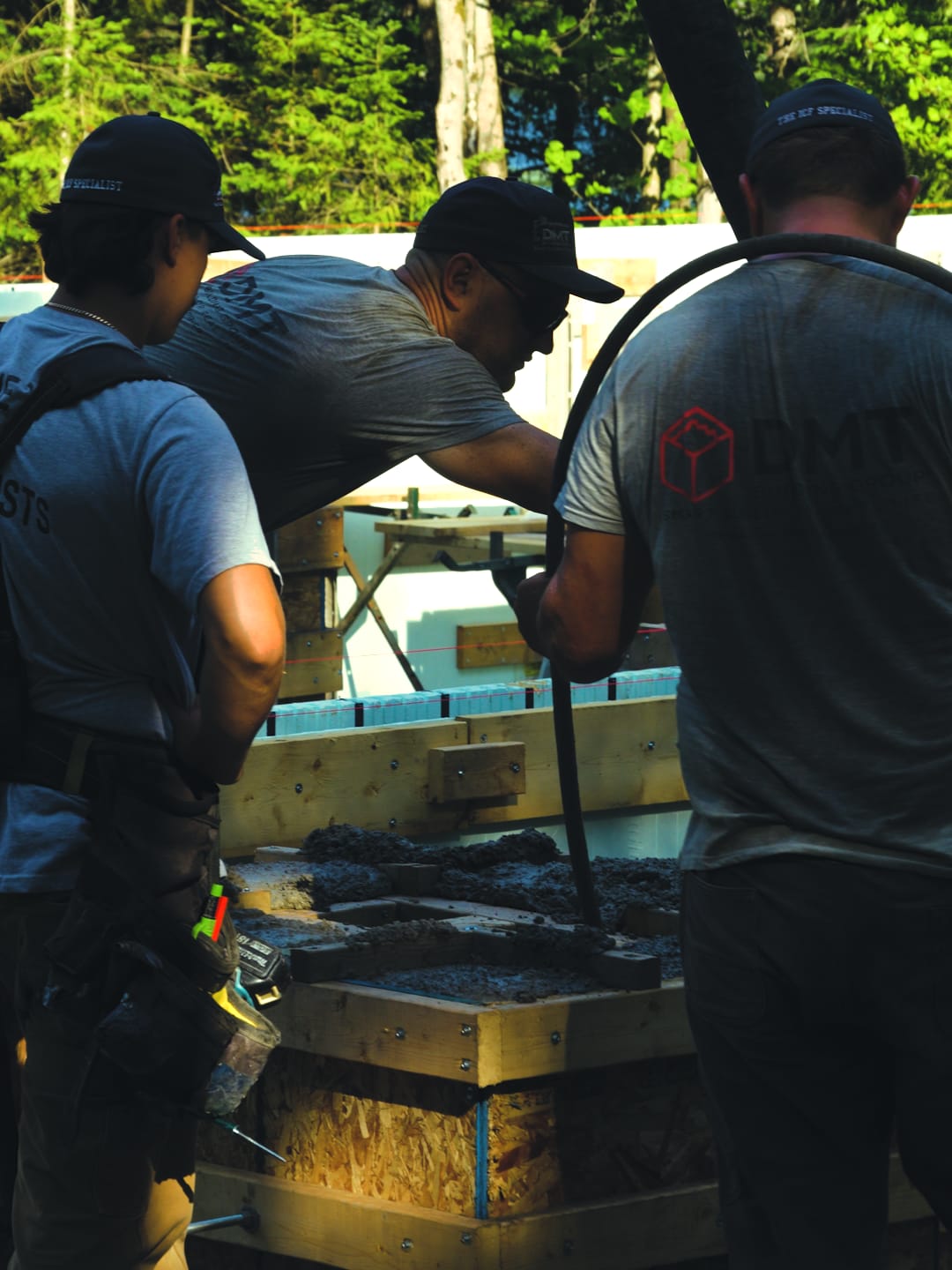
What the crew does during an ICF pour
From the outside it looks like people holding a hose. It is more specific than that.
Someone is managing the hose itself — where the concrete lands, how fast, and keeping the fall short so the mix does not separate on the way down. Someone is consolidating, working the concrete so it fills around the rebar and the webs without leaving voids, and without over-vibrating it into a soupy mess. And at least one person is doing nothing but watching the forms: looking down the wall for a bulge, listening for the sound a brace makes when it is unhappy, checking corners and openings, which are where problems start.
Corners, bucks and column forms take the most attention because they concentrate pressure. The photo above is a column form partway through — three people on one small part of the pour, because that is where it is worth having three people.
Why alignment is everyone else’s problem
A foundation is handed off. The framer, the floor system, the trades and eventually the drywall all inherit whatever the concrete crew leaves behind.
A wall that is plumb, square and level means the floor assembly lands the way the engineering drew it, and the walls above go up without shimming. A wall that is out means every trade after it spends money correcting something they did not cause. That is why the walls get checked at every lift rather than once at the end — by the end, checking is just finding out.
You can see what that produces on the Pebble Ridge footing-and-foundation package, where the stepped plan had to be right the first time.
After the truck leaves
The pour is not the end of the day. Concrete keeps moving while it is plastic, so the crew stays with the wall: final alignment checks and adjustments while there is still time to make them, tops finished, anchors and connections set to the drawings.
Then it cures, protected as the conditions require, and the rest of the scope follows — stripping bracing, waterproofing and drainage, backfill. On an ICF wall the forms themselves stay, which is the whole point of the system and the reason the wall comes out of the ground already insulated. That difference is covered in ICF vs poured concrete foundation.
How DMT runs a pour
The below-grade scope sits with one crew: layout and excavation coordination, footings, pads and piers, weeper and interior stone so drainage is in before the walls go up, then the insulated concrete walls set, braced, aligned and poured in controlled lifts.
Walls are braced and aligned on Giraffe scaffold and checked at every lift, because every trade after us inherits whatever we leave behind. The crew in these photos is ours — DMT self-performs the concrete scope rather than subcontracting the part of the build that decides everything above it.
If you have a foundation coming up and want to know what your lot allows for access and staging, tell us about the project. The consultation and the itemized quote are free, and the full below-grade scope is on our ICF foundations page.