Below 5°C, the Town Has Rules. We Build to Them.
Gravenhurst publishes its own cold-weather requirements for concrete. We form, brace and pour ICF foundations to them, through the months when most sites close.
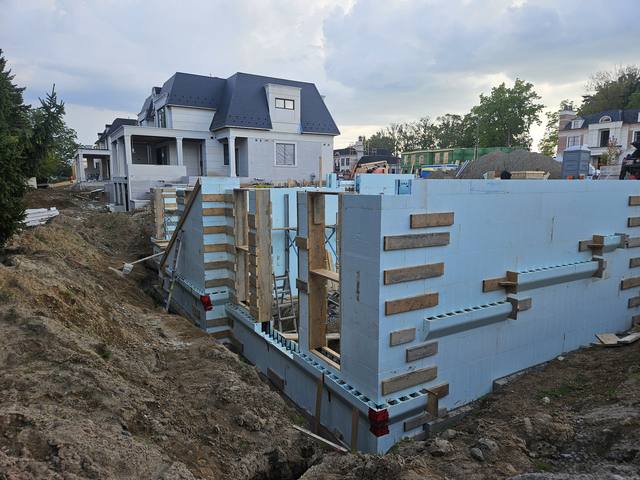
Some people searching insulated concrete forms Gravenhurst are looking for somewhere to buy the block. We are not that. DMT Building Group is an installer and builder: our crews set the forms, brace and align them, place the steel and pour the concrete. We are certified installers on four systems, Nudura, Amvic, Element and Fox, and the forms on your job are whichever one suits it.
If you want the foundation built, rather than the material delivered, read on. We are based in Barrie, Ontario, and Gravenhurst is on the list of Muskoka towns we publish as our service area. Below-grade work is the bulk of what our crews do, on level lots and on stepped rock alike.
And if you are building in Gravenhurst, there is one document the Town has published that shapes a foundation more than any brochure from a block manufacturer. It is about the cold.
The Town of Gravenhurst's building department lists a short guide called Cold Weather Requirements for Concrete among its permit resources, written as guidelines under the Ontario Building Code. It starts with a trigger: the requirements apply whenever the air temperature is below 5°C, which can mean a cold morning in May as much as a week in January.
When they apply, the Gravenhurst guide sets out four things:
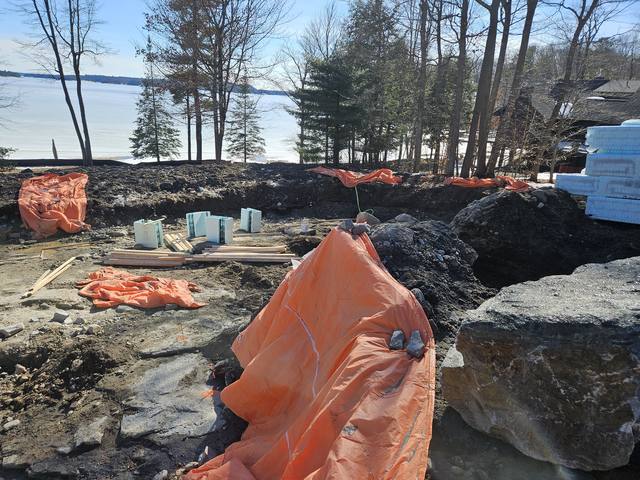
It then moves to the site. Insulated tarps or blankets, hay or other methods should keep the undisturbed soil from freezing. Whatever heating is used should extend past the forms to protect the excavation. Water and organic material left by melted snow and ice must be cleared out of the forms. Fresh concrete has to be protected from freezing until it has cured, and Gravenhurst recommends a cold-weather additive in the mix.
The part of the Gravenhurst guide that decides schedules is the last column, about inspection. When you call for a footing inspection, the forms and any rebar have to be substantially complete. While cold-weather requirements are in effect, the footing forms should be protected before the inspection, and at the inspection they have to be uncovered or easy to see at any point.
Then Gravenhurst says what will fail. An inspector will not approve the inspection if the undisturbed soil appears frozen, if there is ice in the forms, or if the work is not substantially complete. And one line that matters on a lot of Gravenhurst land: forms on bedrock must be kept free of snow and ice.
In Gravenhurst a failed footing inspection is not just a return visit. Gravenhurst asks for 48 hours' notice to book an inspection, through Cloudpermit or by phone, so a failure costs at least two days with the excavation open and the blankets back on. On a winter site that is two more days of heat and protection on the bill. The way to avoid it is to treat the inspection as part of the cold-weather plan, not something that happens after it.
An ICF wall is poured into forms made of foam, and the forms stay on. The moment the concrete goes in, it is wrapped on both faces in continuous insulation, which is the protection a bare wall would need blankets and hoarding to get. The concrete's own curing heat is held in. That is a real advantage against the Gravenhurst 72-hour requirement, and it is the reason we can keep raising walls through a Muskoka winter.
It is not the whole answer, and anyone selling it as one is overselling. Footings are not poured inside foam, and they sit on the ground the Town wants kept unfrozen. Slabs and any exposed top surface need conventional protection. The ground rules in the Gravenhurst guide apply in full whatever the walls are made of. Here is how the season divides up on our Gravenhurst sites:
One more line in the Town of Gravenhurst guide is worth noticing if you are comparing ICF with a block foundation. Its masonry rules, mortar kept at 5°C for 48 hours and the top of unfinished masonry covered whenever work stops, apply to block walls. An ICF wall is poured concrete, so it falls under the concrete rules instead, with the forms already doing part of the work.
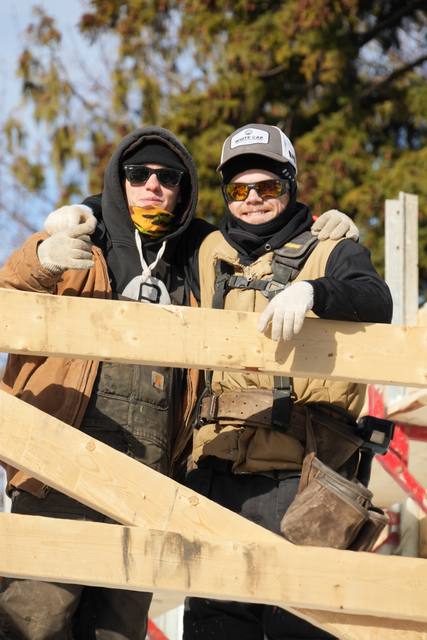
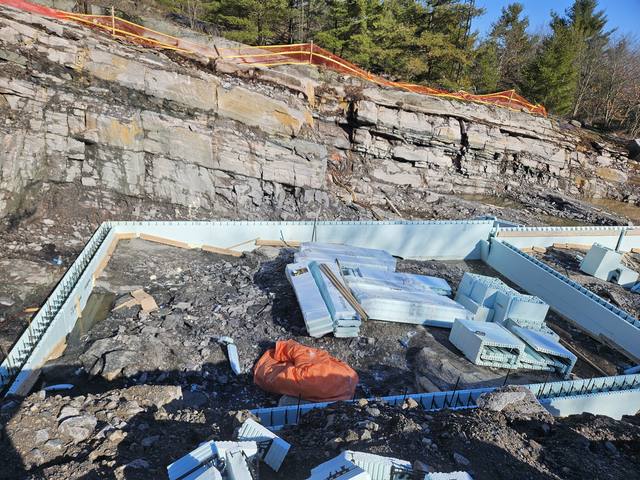
Builders often bring us in for the foundation alone; homeowners usually have us carry on into the above-grade walls. The crew and the standard do not change.
Formed to soil, or scribed and pinned to rock, with forms on bedrock cleared before the inspector arrives.
Braced and aligned on Giraffe scaffold and checked at every lift, on 6" or 8" cores for most houses.
Runs that step down with the grade on sloped and rocky lots, each one level for the wall above.
Weeper, interior stone, exterior waterproofing and drainage, by the crew that poured the walls.
Being straight about it: winter work costs more. Heated mix, additives, blankets, hoarding, fuel and snow clearing are real line items, and a storm still stops a day. What winter buys is a season. A foundation poured in February is a foundation the framers can start on in spring, instead of a hole waiting for the ground to thaw.
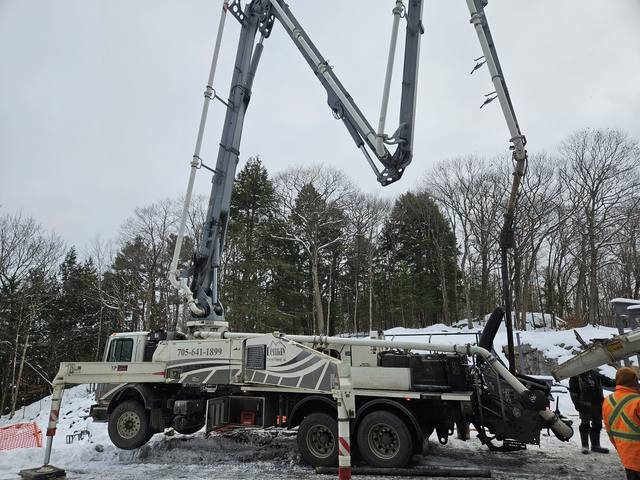
On a Gravenhurst lot, whether that trade is worth making depends on access as much as anything. A pump truck needs a plowed, solid pad, and a lake lot down a seasonal road is a different site in February than in October. We will tell you which side of that line your Gravenhurst lot is on after one site walk. If you are weighing ICF more generally, ICF vs a poured concrete foundation and whether ICF foundations need waterproofing cover the questions we hear most.
Ground, rock, access, and whether a winter start makes sense on this Gravenhurst lot.
Excavation covered and insulated so the bearing surface never freezes.
Forms and steel complete, uncovered for the Gravenhurst inspector, then poured and protected.
Set, braced, poured in controlled lifts, tops covered, waterproofed and ready to backfill.
No. We are installers and builders, certified on Nudura, Amvic, Element and Fox. We form, brace and pour ICF foundations and walls.
When the air temperature is below 5°C. Concrete must then be kept between 10°C and 25°C while mixed and placed, and at 10°C or more for 72 hours after placing.
The Town's guide says an inspector will not approve it if the undisturbed soil appears frozen, there is ice in the forms, or the work is not substantially complete. Forms on bedrock must be kept free of snow and ice.
For the walls, the foam forms provide much of it, because they stay on and insulate both faces. Footings, slabs and exposed tops still need conventional protection, and the ground must not freeze.
The Town asks for 48 hours' notice, booked through Cloudpermit or by phone, with the permit number, address, inspection type and requested date.
No. We are based in Barrie, and Gravenhurst is one of the Muskoka towns on our published service area.
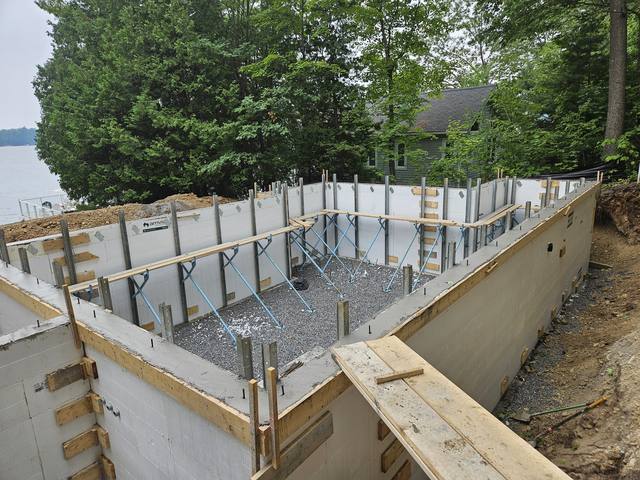
Everything inside our foundation scope, from layout to backfill-ready.
See the service →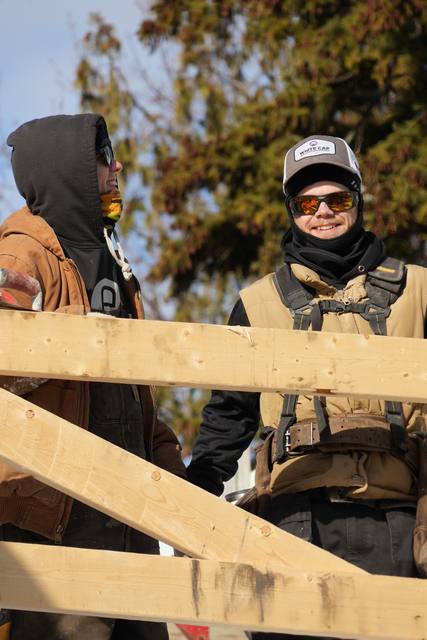
The mix, the ground and the protection, and what a winter start really costs.
Read the post →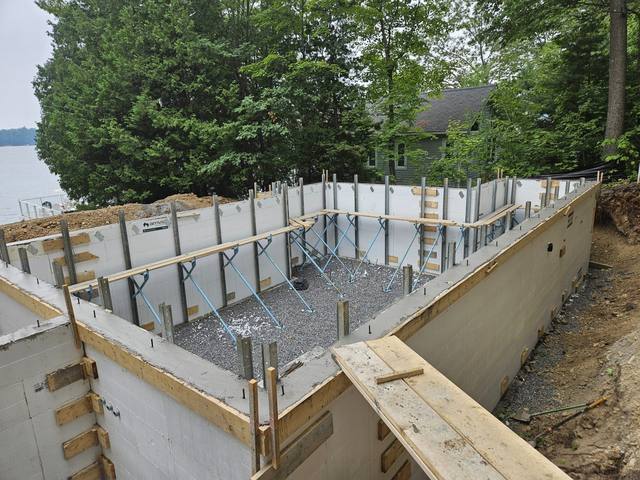
How a footing goes onto Shield rock, step by step.
See the service →Send us the lot, the drawings and when you want to start. We will tell you honestly whether a winter start makes sense, and come back with an itemized quote.
Prefer to talk? 705-333-3329 · info@dmtbuilding.ca
One short form — the property, what you're planning, and any drawings or site photos you have. We'll come back with straight answers.
Start my free quoteOr talk to us now — 705-333-3329
Monday–Friday, 7 a.m.–5 p.m. · Closed weekends