"Is ICF fireproof?" is one of the first things people ask when they see a wall that starts life as white foam, and the straight answer is no. Nothing in a house is fireproof. Concrete is not, steel is not, and the foam on an ICF wall certainly is not.
What a wall can be is fire-rated: tested, in a furnace, to hold back a fire and keep carrying its load for a stated number of hours. That number is the useful answer, and it depends on things a homeowner never sees in a brochure, including the thickness of the concrete and the drywall screwed to the face.
Fireproof Is the Wrong Word for Any House
Everything burns, melts or fails if the fire is hot enough and lasts long enough. Building codes do not ask whether a material survives fire. They ask two narrower questions: does this material add fuel to a fire, and how long does this assembly hold one back?
Those are different questions, and an ICF wall answers them differently for each of its layers. The concrete core does not burn. The expanded polystyrene around it does. The drywall on the inside is what keeps the second fact from mattering in a room.
So the honest version of is ICF fireproof is really three questions. What does the concrete do? What does the foam do? And what does the finished wall do, tested as a whole?
What a Fire-Resistance Rating Actually Measures
Wall ratings under the National Building Code come from CAN/ULC-S101, the standard fire endurance test. A full-size wall goes into a furnace that follows a fixed time-temperature curve. It is watched for how long it contains the fire and keeps its structural integrity, and most walls also face a fire hose stream afterward to see whether they hold together under the impact.
Two things about that test matter more than the hours.
It rates an assembly, not a material. The rating belongs to a wall built a particular way: this thickness of concrete, this steel, this finish, fastened like this. Change one of those and the rating no longer applies to what you built.
It measures the fire, not the aftermath. The standard says plainly that the endurance period describes performance during the exposure and does not establish whether the element is fit for use afterward. A rated wall is a wall that held. Whether it is reused is an engineering decision made later.
Is ICF Fireproof, or Just Fire-Rated? The Listed Hours
Nudura, the system we build with, publishes its fire listing from ULC: Design No. W012, a load-bearing ICF wall. The listing gives it two ratings, and the difference between them is the concrete.
- 2 hours with a concrete core at least 102 mm thick, roughly 4 inches.
- 4 hours with a core at least 152 mm thick, roughly 6 inches.
The tested wall is specific. It has 10M bars in every course and verticals at 400 mm on centre, 20 MPa concrete, and gypsum board at least 12.7 mm thick, screwed into the plastic webs with taped joints. When the wall is an exterior wall and the rating has to hold from both sides, the listing lets 25 mm of concrete or masonry, fastened through to the wall rather than to the foam, stand in for the outside layer of drywall.
That detail is the answer to is ICF fireproof in one sentence: the hours come from the concrete, but only when the foam is covered the way the test covered it. Our commercial and industrial page says concrete assemblies deliver superior fire resistance ratings, and this listing is where a rating like that comes from. Nudura's own specification also lists the forms for fire-resistive and non-combustible construction, subject to the code that applies to the building.
What the Concrete Does in a Fire
Concrete is non-combustible. It does not ignite, does not feed a fire, and gives the wall something to stand on while the rest of the room is burning. That is the whole reason a reinforced concrete core can be rated in hours rather than minutes.
Thickness buys time because concrete heats slowly. A thicker core takes longer to heat through, and the steel inside stays cooler for longer, so the wall keeps its strength longer. That is why the same form system carries 2 hours at one width and 4 at another.
The steel placement matters here too. The plastic webs in each block sit every eight inches and hold the reinforcing in position before the pour, so the bars end up where the engineer drew them, inside the concrete rather than near its face.
What the Foam Does in a Fire
The foam is the part that worries people, and it should be taken seriously. Expanded polystyrene is a plastic. It burns.
What the specification says about the foam
Nudura's specification is unusually frank about it. The EPS carries a flame spread rating of 180 under the surface-burning test, CAN/ULC-S102, and a smoke developed index under 450. Its self-ignition temperature is at least 343 °C. Those are not the numbers of a material you leave bare in a living room, and nobody is supposed to.
The foam used in insulation is not plain packing foam, either. The EPS Industry Alliance notes that flame retardants are added to EPS insulation to raise its ignition temperature, slow its burning and reduce flame spread. Polystyrene also melts and shrinks back from heat at low temperatures, well before it reaches the point where it ignites on its own.
Why the code insists it is covered
Article 9.10.17.10 of the National Building Code requires foamed plastic insulation to be protected from the room beside it by an interior finish, gypsum board with taped joints being the usual one. That rule covers every foam insulation in a house, not just ICF. Rigid board under a basement finish and spray foam in a rim joist have to meet it as well.
Outside, above grade, the foam is clad for the same reason it is clad against sunlight: it is never meant to be the surface anyone sees.
Why the Drywall Is Part of the Wall
On a framed wall, drywall is a finish. On an ICF wall, for fire purposes, it is a working layer of the assembly. The W012 rating was earned with the gypsum on, and the code requirement for covering foam would apply even if the rating did not.
ICF makes that easy, because the board fastens straight to the webs with no studs or strapping in between. Our ICF foundations page puts it simply: drywall fastens straight to the form, even below grade. The practical detail is in can you put drywall directly on ICF.
The trap is a basement or garage left unfinished "for now", with the foam bare and the space used for storage. That is exactly the room the code rule was written for.
What Still Burns in an ICF House
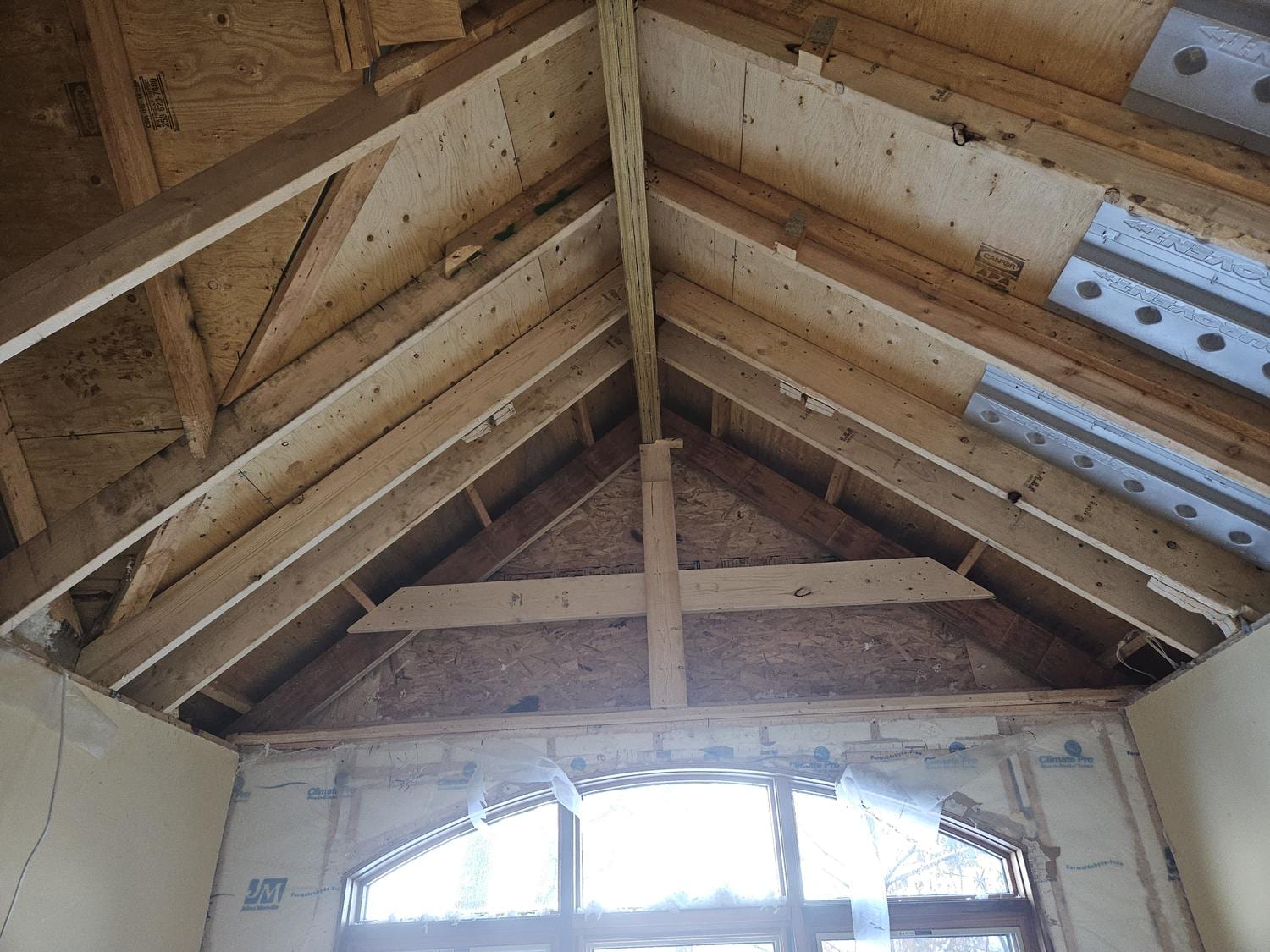
A fire-rated wall is not a fire-rated house. In most ICF homes, the parts above and between the walls are built the usual way.
- The roof. Rafters or trusses and their sheathing are typically wood, and an attic fire is an attic fire whatever is holding up the eaves.
- The floors. Floor systems are commonly wood joists or engineered joists bearing on the concrete.
- The contents. Furniture, finishes and everything in the garage are where most house fires get their fuel.
- The openings. Windows and doors are the weak points in any rated wall, because glass and frames do not carry the wall's rating.
What ICF changes is the box around all of that. The exterior walls will not carry a fire up through a stud cavity, and they will not burn through. That is a real difference. It just is not the same as a building that cannot burn.
Is ICF Fireproof After the Fire Is Out?
A wall that held for its rated time has done its job. It does not follow that it goes back into service as it is, and the test standard says so in as many words. After a serious fire, an engineer assesses the concrete and the steel, and any foam and finish that took the heat comes off and is replaced.
The difference is what is left to assess. A stud wall that burned through has to be rebuilt. A reinforced concrete wall that was rated for hours is usually still standing, and what an engineer is judging is whether it is still sound, not whether it is still there.
So, is ICF fireproof?
No, and anyone who tells you otherwise is selling you a word. An ICF wall is a non-combustible, reinforced concrete core inside a foam form that the code requires to be covered. Built to its listing, with the right core thickness and the drywall on, that wall carries a 2-hour or 4-hour rating. The foam is the reason the drywall is not optional, and the concrete is the reason the hours are possible.
Jerry has been building in insulated concrete for more than twenty years, and we are certified installers of Nudura, Amvic, Element and Fox. If fire separation matters on your project, whether it is a house close to the next one or a commercial building with a rating to meet, send us your drawings and we will tell you what core thickness and finish it takes to get there.